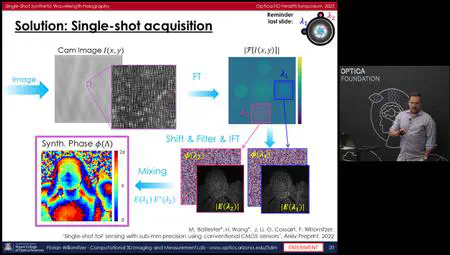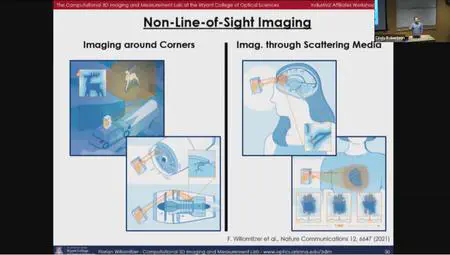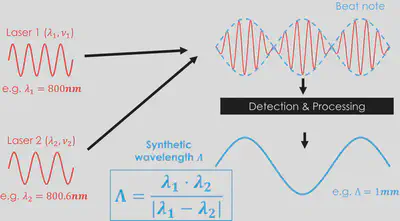
Here, we tackle the problem of seeing through scatter with our Synthetic Wavelength Imaging (SWI) approaches - an ensemble of techniques that leverage the information encoded in the beat frequency between two coherent optical fields at closely spaced wavelengths to image through scatter. Our approaches probe the scene at two (or more) closely spaced optical wavelengths and computationally assemble a complex “synthetic field” at a “synthetic wavelength,” which is used for further processing. As the synthetic wavelength is the beat wavelength of the two used optical “carrier” wavelengths, it is freely tunable and can be picked orders of magnitudes larger, so that the computationally assembled synthetic field becomes immune to scatter. Moreover, the fact that “optical” light (e.g., in the VIS or NIR) is still the carrier or the information allows us to use of off-the shelf detector technology such as CMOS cameras. As the synthetic wavelength depends solely on the difference between the two used optical “carrier” wavelengths, the same synthetic wavelength can be realized for different carrier wavelengths pairs in different wavebands best suited for specific tasks (e.g., minimizing absorption).
Besides the various SWI-based approached to image through scattering environments discussed below, our group has harnessed SWI as “high precision Time-of-Flight imaging” method to recover 3D profiles of optically rough surfaces in industrial inspection and computer vision applications (please see ”High-Precision Time-of-Flight Sensing with Synthetic Waves” below for more information).
Synthetic Wavelength Holography was Northwestern’s #3 media story in the week of Nov. 18-24, 2021 with a total reach of 3.2 million people within this week.
Official Northwestern research news release:
“New holographic camera sees the unseen with high precision” (Northwestern Now Research News, Nov. 17, 2021)
For Journalists: News release for media contacts and assets.
Research news featured on Northwestern websites:
[Northwestern McCormick School of Engineering (retrieved Nov. 18, 2021)]
[Northwestern Electrical and Computer Engineering (retrieved Nov. 18, 2021)]
[Northwestern Computer Science (retrieved Nov. 18, 2021)]
Research news featured on external websites (selection):
Newsweek: “This Holographic Camera Can See Around Corners, Under Human Skin” (Nov. 19, 2021)
NSF.gov: “High-resolution camera can see around corners and through scattering media” (Dec. 7, 2021)
SCIENTIFIC AMERICAN: “Holographic Camera Instantly Peeks around Obstacles” (Jan. 19, 2022)
Optics.org: “Northwestern University camera sees around corners” (Nov. 18, 2021)
Phys.org: “New holographic camera sees the unseen with high precision” (Nov. 17, 2021)
Daily Mail: “Powerful holographic camera is developed that can see through …” (Nov. 19, 2021)
Photonics.com: “Holographic Camera Peers Through Fog, Around Corners” (Dec., 2021)
AI in Healthcare: “Novel camera images objects around corners, behind barriers” (Nov. 19, 2021)
Science X: “Best of Last Week – Camera sees around corners, ….” (Nov. 22, 2021)
New Atlas: “Holographic camera reconstructs objects around corners in milliseconds” (Nov. 17, 2021)
IFL Science: “New Holographic Camera Can See Around Corners – Or Inside Your Skull” (Nov. 19, 2021)
Mashable: “Researchers Develop Camera That Can See Through Skin And Around Corners” (Nov. 18, 2021)
ZME Science: “Holographic camera can see around corners or even through the skin” (Nov. 18, 2021)
More…
[ScienceDaily] |
[SciTechDaily] |
[SpaceLiveNews] |
[Unite AI] |
[AZO Optics] |
[Newsfounded] |
[Nerdswire] |
[Florida News Times] |
[PetaPixel] |
[Brinkwire] |
[Remonews] |
[Futurism] |
[InterestingEngineering] |
[TodayIn24] |
[Engineering and Technology] |
[XNewsNet] |
[NewsBeezer] |
[CVBJ] |
[The Washington Newsday] |
[CaliforniaNewsTimes] |
[ScienceTimes] |
[Techeblog] |
[WoonderfulEngineering] |
[6parkNews] |
[Newscon] |
[iTechpost] |
[WorldIndustrialReporter] |
[California18] |
[Jioforme] |
[Techgamingreport] |
[Newsbrig] |
[Algulf] |
[Funtitech] |
[Leakherald] |
[Shouzy] |
[NewsInseconds] |
[MessageToEagle] |
[XNewsNet] |
[MarketResearchTelecast] |
[ScienceSprings] |
[MORE…]
International News Coverage (selection):
Report on German TV (German) - Short report about our work on Synthetic Wavelength Holography and Portrait about Florian was aired on German (Bavarian) TV on 03/20/2022 [German language only]. Click here to watch video.
Pressetext (German): “Neuartige Kamera zeigt versteckte Objekte” (Nov. 18, 2021)
c’t (German): “Holo-Kamera sieht um die Ecke " (Dez. 12, 2021)
VIDEO: Yahoo News (German): “Neue Technologie: Holografische Kamera kann um Ecken sehen” (Nov. 18, 2021)
FutureZone (German): “Neue holografische Kamera macht das Unsichtbare sichtbar” (Nov. 17, 2021)
EuropaPress (Spanish): “Nueva cámara holográfica ve lo invisible con alta precisión” (Nov. 17, 2021)
Trust My Science (French): “Une caméra qui permet de voir à travers les objets” (Nov. 17, 2021)
More…
[VIDEO: MSN News (German)] |
[VIDEO: Wissen.de (German)] |
[NachWelt (German)] |
[Inuit (German)] |
[ICT (German)] |
[SputnikNews (Turkish)] |
[Descopera (Romanian)] |
RT News (Spanish) |
[Techvet (Czech)] |
[KisaKisa (Turkish)] |
[Tamindir (Turkish)] |
[Fizikist (Turkish)] |
[ScienceNet (Chinese)] |
[ITMedia (Chinese)] |
[MORE…]
Research news featured on official University of Arizona Websites:
UA Health Sciences Connect newsletter (retrieved Oct. 15, 2025)
UANOW newsletter (retrieved Oct. 15, 2025)
Inside Arizona Research (retrieved Oct. 15, 2025)
Research news featured on external websites (selection):
Digital Journal: “Imaging tech set to help doctors diagnose skin cancers” (Oct. 24, 2025)
The Engineer: “Imaging tech to provide deeper view of skin cancers” (Oct. 8, 2025)